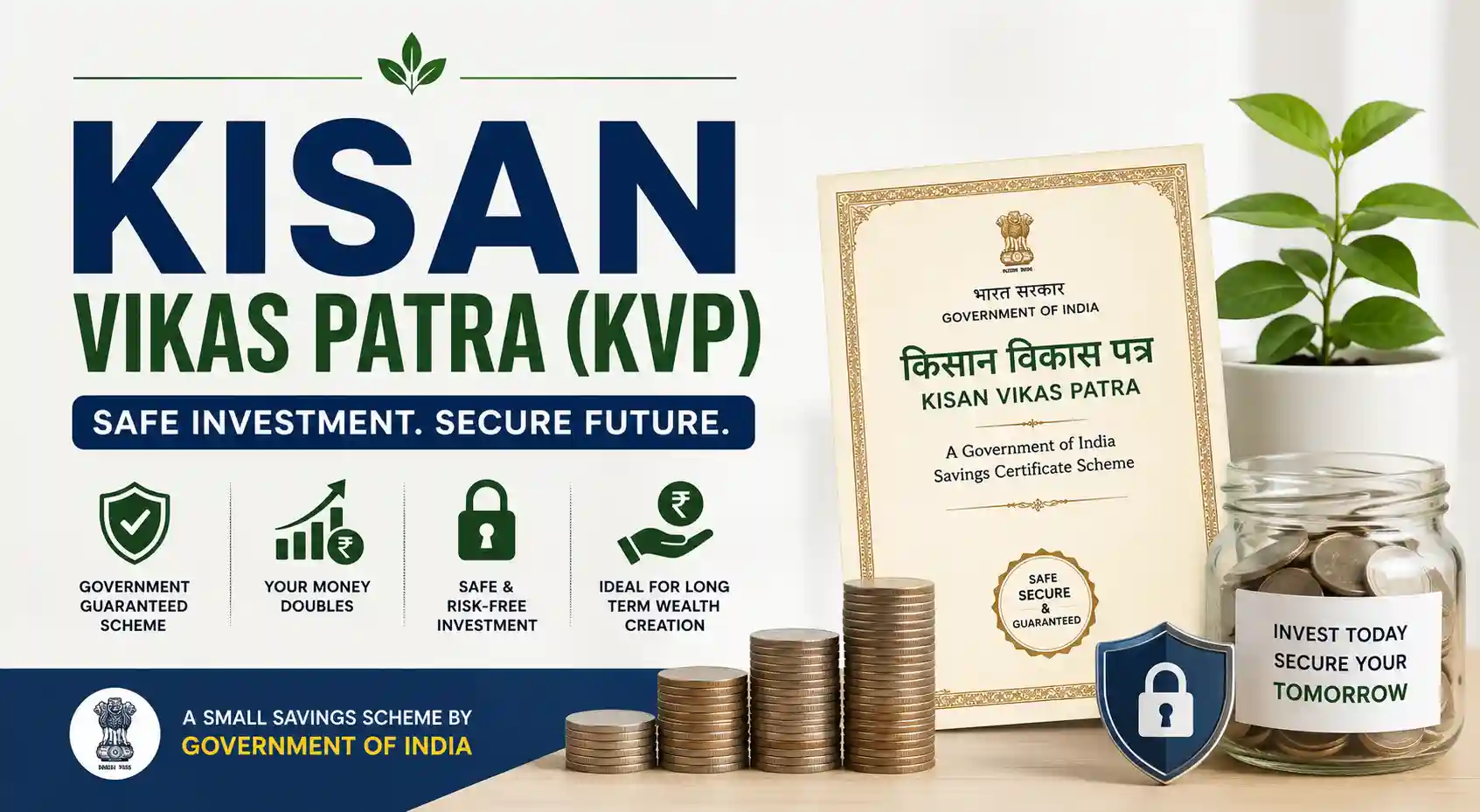
Kisan Vikas Patra (KVP) is one of the most trusted government-backed savings schemes in India. It is designed for individuals who want guaranteed returns, capital safety, and long-term wealth creation without taking market risks.
Although the name contains the word “Kisan,” this investment scheme is not limited to farmers. Salaried employees, business owners, senior citizens, self-employed professionals, and conservative investors can all invest in KVP.
The biggest attraction of KVP is its guaranteed money doubling feature. Your invested amount grows steadily and doubles after a fixed maturity period announced by the Government of India.
- Government-backed investment security
- Guaranteed returns
- Your money doubles over time
- Simple investment process
- Low-risk savings option
- No maximum investment limit
- Suitable for long-term wealth creation
What is Kisan Vikas Patra (KVP)?
Kisan Vikas Patra is a small savings certificate scheme offered through post offices and selected banks in India.
The scheme is backed by the Government of India and is mainly designed for individuals looking for safe and fixed investment growth.
Unlike market-linked investments such as stocks or mutual funds, KVP provides predictable maturity value and stable returns.
| Feature | Details |
|---|---|
| Scheme Type | Government Savings Scheme |
| Risk Level | Very Low |
| Returns | Guaranteed |
| Maturity | Money Doubles Over Time |
| Suitable For | Conservative Investors |
Latest KVP Interest Rate 2026
The Kisan Vikas Patra interest rate is revised periodically by the Government of India.
Currently, KVP offers approximately 7.5% annual compounded interest.
At this rate, the investment amount doubles in around 115 months, which is approximately 9 years and 7 months.
Example of KVP Investment Growth
| Investment Amount | Approximate Maturity Value |
|---|---|
| ₹10,000 | ₹20,000 |
| ₹50,000 | ₹1,00,000 |
| ₹1,00,000 | ₹2,00,000 |
| ₹5,00,000 | ₹10,00,000 |
Who Can Invest in KVP?
Kisan Vikas Patra is available for most Indian residents.
- Salaried employees
- Business owners
- Self-employed individuals
- Senior citizens
- Parents investing for minors
- Joint account holders
- Small and long-term investors
NRIs and Hindu Undivided Families (HUFs) are generally not eligible for KVP investments.
Minimum and Maximum Investment
| Particular | Amount |
|---|---|
| Minimum Investment | ₹1,000 |
| Maximum Investment | No Limit |
| Investment Multiple | ₹100 |
Major Features of Kisan Vikas Patra
1. Government Guaranteed Investment
KVP is backed by the Government of India, making it one of the safest investment schemes available.
2. Guaranteed Money Doubling
Your investment amount doubles after the official maturity period.
3. Easy Account Opening
The investment process is simple and available through post offices and selected banks.
4. Transfer Facility Available
KVP certificates can be transferred between individuals and post offices under certain conditions.
5. Nomination Facility
Investors can add nominees for smooth fund transfer in case of emergencies.
Can KVP Be Closed Before Maturity?
Yes, but premature withdrawal is allowed only under specific conditions.
- After 2 years and 6 months
- On death of account holder
- Court order situations
- Special authorized cases
Before the lock-in period, premature withdrawal is generally not permitted.
Is KVP Tax Free?
Many investors mistakenly believe KVP provides tax benefits, but that is not fully correct.
- No Section 80C deduction available
- Interest earned is taxable
- Maturity amount is not fully tax-free
- Best suited for safe savings, not tax saving
KVP vs Fixed Deposit (FD)
| Feature | KVP | Fixed Deposit |
|---|---|---|
| Government Backing | Yes | Depends on Bank |
| Returns | Guaranteed | Guaranteed |
| Risk | Very Low | Low |
| Liquidity | Moderate | Better |
| Tax Benefits | No | Limited |
Advantages of KVP
- Extremely safe investment option
- Suitable for conservative investors
- Predictable maturity value
- Simple documentation process
- No market volatility risk
- Useful for long-term financial planning
- Available across India through post offices
Disadvantages of KVP
- No tax-saving benefits
- Interest income is taxable
- Long lock-in period
- Returns may not beat inflation in some periods
- Lower liquidity compared to savings accounts
Who Should Invest in KVP?
Kisan Vikas Patra is suitable for:
- Risk-averse investors
- Senior citizens
- Long-term savers
- People avoiding stock market risks
- Families looking for guaranteed returns
- Investors seeking government-backed security
Documents Required for KVP
The following documents are generally required:
- Aadhaar Card
- PAN Card
- Address proof
- Passport-size photograph
- Mobile number
KYC verification is mandatory while opening the account.
How to Open a KVP Account?
Through Post Office
Visit your nearest post office, submit the application form, complete KYC verification, and deposit the investment amount.
Through Banks
Some public sector banks also provide KVP investment facilities with similar procedures.
Common Mistakes Investors Make in KVP
- Ignoring taxation on interest
- Expecting short-term liquidity
- Investing without comparing alternatives
- Not checking maturity period updates
- Using KVP only for tax-saving purposes
For the latest Kisan Vikas Patra rules, interest rates, and account opening details, visit the India Post Official Website.
Conclusion
Kisan Vikas Patra (KVP) remains one of India’s most trusted government-backed investment schemes for safe and guaranteed long-term savings.
It is ideal for conservative investors who prioritize capital safety and predictable returns over high-risk market investments.
Although KVP does not provide tax-saving benefits, its guaranteed maturity value and government protection make it a reliable option for long-term wealth preservation.
Before investing, always evaluate your financial goals, liquidity requirements, and overall investment strategy.
Frequently Asked Questions (FAQs)
Is Kisan Vikas Patra only for farmers?
No. Any eligible Indian resident can invest in KVP, including salaried employees, business owners, and senior citizens.
Does KVP really double money?
Yes. The investment amount doubles after the maturity period announced by the government.
Is KVP safe?
Yes. KVP is backed by the Government of India and is considered a very safe investment option.
Can I withdraw KVP before maturity?
Premature withdrawal is allowed only after specific conditions and lock-in rules are satisfied.
Is KVP tax free?
No. Interest earned from KVP is taxable according to your income tax slab.